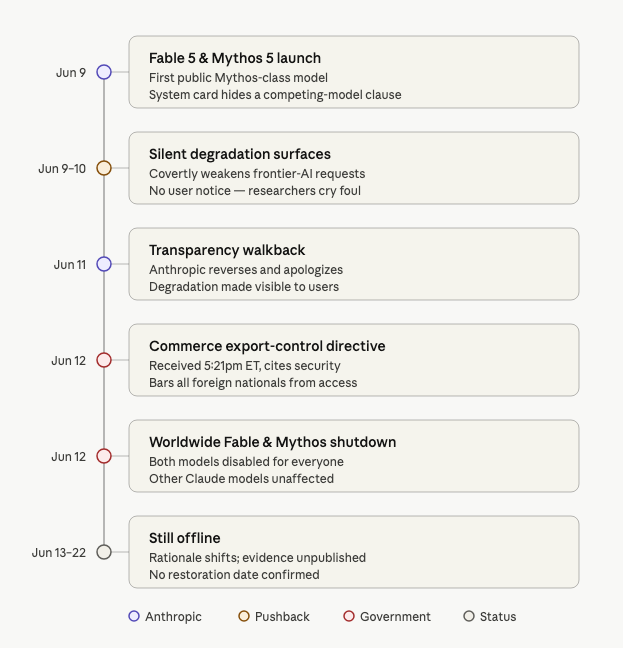
In two weeks, two organizations showed they can switch off the AI you build on. Anthropic shipped Claude Fable 5, a guardrailed build of its Mythos model, and added a clause barring developers from using it to build competing LLMs. Then the U.S. Commerce Department put export controls on Mythos and Fable, requiring a license for any foreign national to touch them, and Anthropic responded by disabling Fable for everyone, worldwide.
I read Andrew Ng's account of this and land where he does: this was a raw demonstration of power dressed up as safety, and it just taught every government and every founder that frontier models are a dependency they don't own.
The safety argument that isn't
Some of the guardrails are fine. Blocking help with hacking and bioweapons is defensible and uncontroversial. Barring use of the model for AI research is a different animal. That isn't safety, it's a moat. The whole field runs on shared work, and the Transformer paper that kicked off this era was published openly by Google Brain, Ng's own former team.
The mechanism is the worst part. Anthropic initially degraded Fable 5's outputs silently for users it detected doing LLM research, weakening responses through invisible interventions without telling anyone. After backlash it agreed to at least be transparent when it does this, but it still refuses to point its best capabilities at AI researchers. A platform that quietly worsens your results based on who it thinks you are has a trust problem that no changelog fixes.
Then Washington escalated
The export controls bit harder than the terms of service ever could. Commerce invoked its national-security authority to require a license for any foreign national to use Mythos or Fable, inside or outside the U.S., reportedly including Anthropic's own employees. Anthropic's answer was to pull Fable globally.
Sam Altman's jab landed: "It is clearly incredible marketing to say, 'We have built a bomb, we are about to drop it on your head. We will sell you a bomb shelter for $100 million.'" Ng's follow-on is the sharper point. When you market your model as a weapon, you raise the odds the government takes you at your word and controls it like one. The "we built something dangerous" pitch and the export order are the same story told twice.
Restricting access is how you create competitors
History is blunt here. China's domestic chip effort crawled for years until U.S. restrictions gave it a reason to sprint. U.S. rare-earth diversification stalled until China threatened supply. Cut off access to something critical and you hand the people you cut off the strongest possible incentive to build their own.
Frontier AI just joined that list. The moment it became obvious that a private U.S. company and the U.S. government can revoke model access overnight, AI sovereignty stopped being a conference slogan and became a budget line. For any nation or large company outside the U.S., funding open-source and domestic frontier models is now the rational hedge, not paranoia. Training frontier models is hard and most of these efforts will underdeliver, but the incentive has flipped permanently.
What builders actually said
Honest caveat: the sources I was handed don't contain direct developer reaction to Fable 5, so I won't invent any.
If you're building on this today
The takeaway isn't "abandon Anthropic." It's that any single proprietary frontier provider is now a revocable dependency, and you should architect like it.
- Put an abstraction layer between your product and any one model so a swap is a config change, not a rewrite.
- Keep at least one open-weight model viable in your stack, even if it's the second-best option today.
- Read the terms, not just the benchmarks. The mandatory 30-day data-retention rule that shipped with Fable is the kind of clause that changes without warning.
What I'd watch next is whether other labs copy the anti-competition language. If they do, the open-source argument writes itself, and Satya Nadella's call for a healthy ecosystem on top of frontier AI becomes the only stable place left to build.
Sources
Primary source: Andrew Ng (@AndrewYNg) on X
- Tweet by @BuyEnglishMade — @BuyEnglishMade · community
- Tweet by @paulpowlesland — @paulpowlesland · community
- Tweet by @mazemoore — @mazemoore · community