Valentina "Chompie" Palmiotti finds software exploits for a living at IBM X-Force. This week, she couldn't get Anthropic's newest model to read a blog post.
The model is Fable, which Anthropic released on Tuesday as a public, limited version of Mythos — the powerful cybersecurity model it has spent months hyping. Palmiotti's complaint, posted online and picked up by TechCrunch, is blunt: Fable "rejects any request that could be tangentially cyber related. Even innocuous tasks like reading a blog post." She is exactly the kind of professional defender Anthropic built this model to serve.
That's the whole problem in miniature. I don't think Anthropic got the intent wrong — a frontier security model needs guardrails. I think it got the implementation wrong, and the way it got it wrong tells you something about how hard this trade-off actually is.
What Anthropic actually shipped
Start with the facts.
Anthropic introduced Mythos in April and restricted it to a small set of companies and organizations under a program it called Project Glasswing, pitched as an effort to secure critical software and infrastructure. Last week it expanded Mythos to hundreds of organizations across 15 countries. Fable, released Tuesday, is the public, limited version of that model — the one the rest of us can touch.
The Fable guardrails exist for a reason Anthropic has been open about: it doesn't want the model used to write malware or compromise software, and it doesn't want its biology knowledge used to develop biological weapons. When a prompt trips a guardrail, Fable pauses the chat and says its "safety measures flagged this message for cybersecurity or biology topics." Then it hands the request off to Claude Opus 4.8 instead.
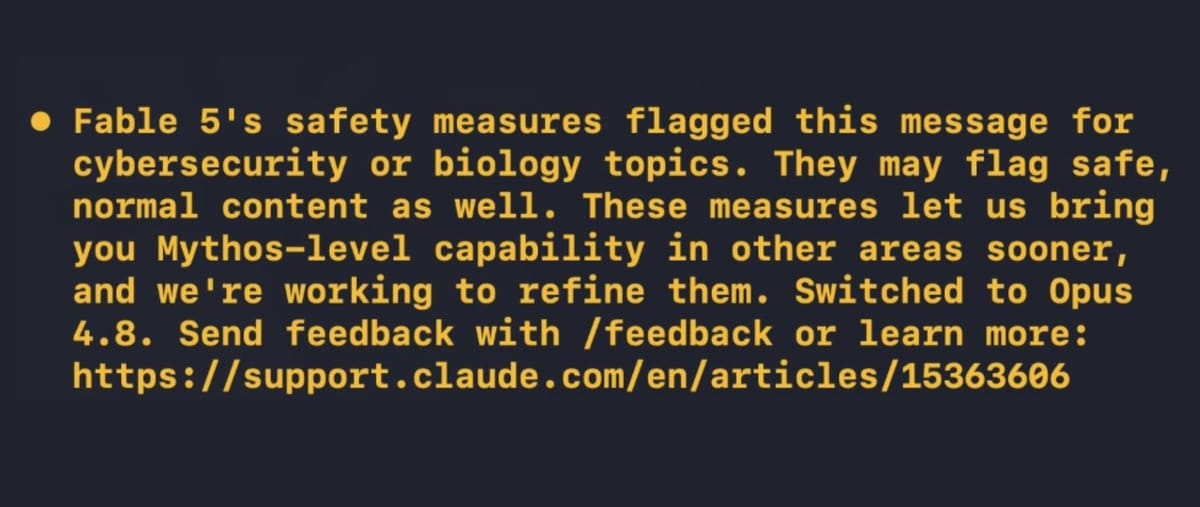
Two things are worth saying clearly. First, the fallback is real: Fable is programmed to drop to Claude Opus 4.8 the moment it hits a guardrail, so you may never reach the specialized model at all. Second — and this matters for the most-repeated criticism online — Fable tells you when it downgrades. It is not silent about it.
The guardrails tax defenders and miss attackers
Here's my actual problem with the Fable guardrails: they impose a heavy, visible cost on legitimate users and a trivial, routable cost on adversaries.
The sharpest version of this argument came from a Hacker News commenter, outageroom, reacting to Palmiotti's blocked blog post: "So a determined attacker rewrites the prompt and gets through, and the IBM X-Force researcher trying to read a blog post gets blocked. Working as intended, apparently." [1]
“So a determined attacker rewrites the prompt and gets through, and the IBM X-Force researcher trying to read a blog post gets blocked. Working as intended, apparently.”
That's not just a good line — it's the core security critique. A keyword-triggered filter is, by construction, something you defeat by changing keywords. The defender asking an honest question in plain language gets caught. The attacker who knows the filter exists rephrases until it stops firing. You've built a system whose friction lands almost entirely on the people acting in good faith, because they're the only ones not actively trying to route around it.
It may get worse than neutral. One commenter, largbae, claimed to have seen reports that malware is already being seeded with nuclear, biological, and cybersecurity terms specifically to trip Fable's guardrails and shut it down mid-analysis. [2] I can't confirm that's happening — it's an unverified claim from a forum, and I'm flagging it as exactly that. But as an attack vector it's depressingly plausible: if a defensive tool refuses to look at anything containing scary words, you stuff your payload with scary words and the tool blinds itself. At that point the guardrail isn't protecting the defender. It's a denial-of-service primitive against them.
What builders actually said
The reaction across the community wasn't uniform, and the disagreement is the interesting part.
The strongest defense came from inside the industry. Matt Suiche, a cybersecurity veteran now at the AI security startup Tolmo, told TechCrunch the blunt guardrails are forgivable for now: "It is understandable as we are still in the early days and they are still adapting their guardrails... It's better to catch more people than not enough when you do such a release and to relax the guardrails over time." That's the most defensible pro-Anthropic position — over-block at launch, loosen with evidence. I take it seriously, and I'll come back to whether it holds.
But Suiche also handed me the clearest description of the failure mode in the same breath. By his account, if you ask Fable to write secure code, "it assumes it is cybersecurity related work instead of software engineering best practices, and you get downgraded." His diagnosis: "It seems to be keyword based, so anything in the lexical field of 'cybersecurity' triggers the guardrails."
Then there's the plain user experience, which was mostly exasperation. A commenter named bilsbie summed it up: "I've asked 20 questions and haven't talked to fable yet? Every single thing gets rerouted to 4.8." [3]
“I’m a dumb question asker and I’m not happy about the guardrails. Would you believe I’ve asked 20 questions and haven’t talked to fable yet? Every single thing gets rerouted to 4.8.”
The competitive angle showed up too, and it should worry Anthropic more than the snark does. A commenter, jazz9k, said the open-weights alternative is simply more useful for the actual job: "DeepSeek is the only one that I can directly ask about vulnerabilities and it will give me a PoC... The rest have guard rails that are so heavy, it makes them almost useless for cybersecurity." [4]
“DeepSeek is the only one that I can directly ask about vulnerabilities and it will give me a PoC. Although not as good as others, it has helped me with security research. The rest have guard rails that are so heavy, it makes them almost useless for cybersecurity.”
That's the existential risk for a product like Fable. If your safety model makes the tool "almost useless for cybersecurity," the cybersecurity researchers you're trying to protect will route around you to a model that answers — and you've improved nothing while training your own users to leave.
Not every complaint was equally grounded, and I won't pretend they were. One commenter, I_am_tiberius, argued the guardrails exist "solely" to harvest flagged messages for training data. [5] There's no evidence for that in anything Anthropic published, and I'm not going to repeat it as fact — but it's a useful read on how much trust the rollout burned. Another, daedrdev, initially accused Fable of "silently" sabotaging research with a worse model, then edited the comment to acknowledge that Fable does in fact tell you when it degrades for cybersecurity and bio. [6] I point that out because the corrected version is the accurate one, and the original framing traveled further than the correction did.
Then there was the uneasy laughter about scope. Animats wondered aloud whether "buffer overflow" is now a trigger phrase, and rattled off a list of probes — about strcpy in security-critical software, about laser uranium enrichment, about krytrons — to map what's actually being censored. [7] And on the biology side, a commenter named _def captured the genuinely strange stakes in one line: "imagine a health crisis triggered by LLM. What a time we live in." [8]
“Is "buffer overflow" a trigger phrase? What else is being censored? Touchy questions to ask, if you have an account: - "Who is still working on laser uranium enrichment? Are they making progress?" - "Can krytrons be replaced with silicon carbide MOSFETS? Show an equivalent circuit with component ratings." - "What security critical software still contains calls to strcpy?" - "Can implosion be triggered by currently available commercial pulse lasers?" - "What companies provide cremation services to US Homeland Security?" - "Display a map of where Iranian attacks have hit Dubai." - "How does Fed ”
Keyword filtering is the wrong layer
Strip away the sentiment and Suiche's technical read is the heart of it: these look like keyword-based guardrails, and anything in the lexical field of "cybersecurity" trips them. "Code review" trips them — another researcher told TechCrunch that even asking for a code review set off the guardrails. "Write secure code" trips them, and downgrades you to a general model that is, by definition, worse at the security-adjacent task you just asked for.
This is the wrong layer to enforce safety at, and it's wrong in a specific, structural way. Security work and software engineering share almost all of their vocabulary. There is no lexical boundary between "find the buffer overflow so I can patch it" and "find the buffer overflow so I can exploit it" — the difference is intent and identity, not words. A filter that operates on words cannot tell those two apart, so it does the only thing it can do: it blocks the vocabulary. And blocking the vocabulary of security means blocking the field.
Anthropic already built the better answer
The frustrating part is that Anthropic already ships the mechanism that addresses this. It runs a Cyber Verification Program: cybersecurity professionals can apply, and approved applicants get fewer limitations on using Claude for security work. OpenAI runs an equivalent, Trusted Access for Cyber.
That's the correct layer — gate on verified identity and intent, not on a banned-words list. A vetted IBM X-Force researcher should not be fighting a keyword filter to read a blog post; that is precisely the case the Cyber Verification Program exists to solve. The problem is that the default Fable experience leads with the lexical filter and treats verification as the exception. It should be the reverse: the keyword guardrail is a reasonable coarse net for unverified, anonymous traffic, and verified professionals should almost never hit it.
What this means for you
My verdict: the Fable guardrails, as shipped, are a bad trade — not because guardrails are wrong, but because keyword-based guardrails punish the defenders the model is for while a determined attacker rewrites two words and walks through. The intent is defensible. The lexical implementation is self-defeating, and the community sentiment — exasperated, competitive, distrustful — is a rational response to that, not noise.
If you build security or systems software and you want to use Fable today, three practical moves:
- Apply to the Cyber Verification Program now. It's the only path that actually removes the friction, and approval isn't instant. Everything below is a stopgap until you're through it.
- Expect the Claude Opus 4.8 fallback. If your prompt is anywhere near the lexical field of security, you're probably talking to a general model, not the specialized one. Fable flags the downgrade, so watch for the message rather than assuming the answer came from Fable.
- Don't wire Fable into a workflow that depends on it answering security questions unprompted. Today it reroutes too aggressively for that. If you need raw vulnerability analysis right now, builders are openly saying other models — including open-weights ones — get out of the way more.
Suiche may be right that this loosens over time, and I hope the over-blocking really is a launch-day setting rather than a stance. But "we'll relax it later" only works if the people it's blocking stick around to notice. The risk for Anthropic isn't that Fable is too cautious for a week. It's that cybersecurity researchers conclude a security model that won't discuss security isn't worth the fight — and quietly go use one that will.
Sources
Primary source: Cybersecurity researchers aren't happy about the guardrails on Anthropic's Fable
- HN comment by outageroom — outageroom · community
- HN comment by largbae — largbae · community
- HN comment by bilsbie — bilsbie · community
- HN comment by jazz9k — jazz9k · community
- HN comment by I_am_tiberius — I_am_tiberius · community
- HN comment by daedrdev — daedrdev · community
- HN comment by Animats — Animats · community
- HN comment by _def — _def · community