DeepSeek just dropped DSpark, a speculative decoding method for its V4 Flash and Pro models, and it didn't stop at a paper. It shipped the draft model and the framework to train your own. [1] That second part is the news. The speedup is impressive; the fact that you can reproduce it is the thing that should worry anyone selling inference at a markup.
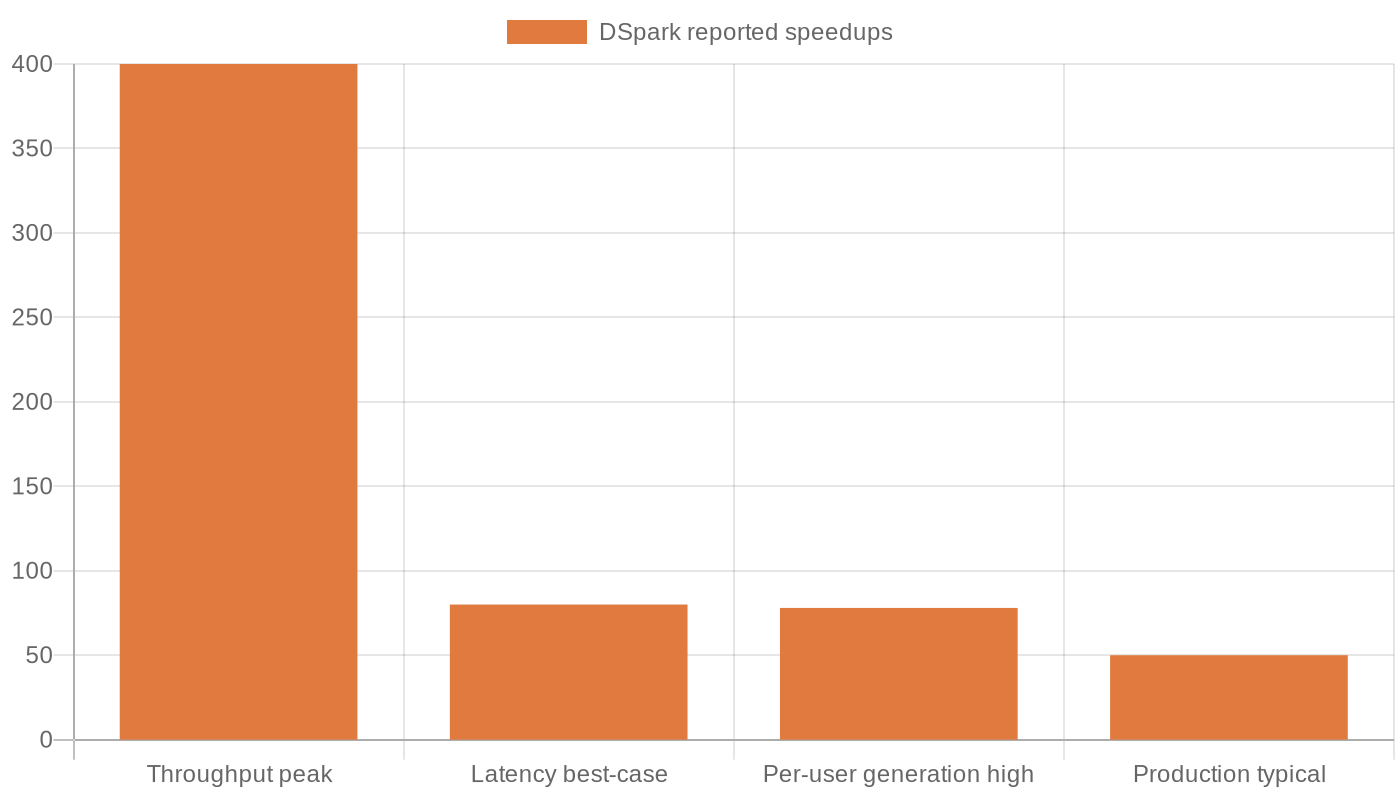
Let me get the numbers out of the way first, because they're being quoted three different ways and the spread matters.
The numbers, and which one to trust
Daniel Han's summary, the most-shared one at 3,095 likes, says DSpark boosts throughput by 51% to 400%. [2] Elie Bakouch, who read the paper closely, reports the production figure for DeepSeek V4 at roughly +50% for both throughput and latency, reaching about 80% on latency. [1] And the paper itself, quoted in the DSpark discussion, claims "57% to 78% faster per-user generation" at matched system capacities. [3]
These aren't contradictions. The 400% is a best-case throughput ceiling under specific batching; the ~50–80% band is what DeepSeek actually sees serving V4 in production. If you're budgeting capacity, plan around the production band and treat 400% as a marketing-true outlier.
What the method actually does
Speculative decoding works by having a small, fast draft model guess several tokens ahead, then letting the big model verify them in one pass. You pay for one expensive forward step and get multiple tokens out of it when the guesses are right.
The interesting design choice in DSpark is where it sits between two existing approaches. It builds on DFlash, which drafts fully in parallel, and Eagle, which drafts fully sequentially, to create what Bakouch calls a "semi-parallel" method. [1] Parallel drafting is fast but accepts fewer tokens; sequential drafting accepts more but is slower to produce. The semi-parallel middle is the engineering bet that you can get most of the acceptance rate of sequential at closer to parallel speed.

DeepSeek also showed DSpark generalizing beyond its own models, with reported gains on Gemma and Qwen. [2] That's what makes the released training framework matter: this isn't a V4-only trick.
The publishing is the story
Here's my actual position. The speedup is a quarter of why this release matters. The other three-quarters is that DeepSeek explained how it did it, in detail, with code.
A widely upvoted sentiment in the thread put it bluntly: DeepSeek keeps publishing papers explaining its gains, "something the American labs no longer do," and Chinese labs "are doing the most interesting work in AI right now." [4] You can roll your eyes at the triumphalism, but the structural point holds. OpenAI and Anthropic do not ship the draft model and training harness for their inference optimizations.
And there's a cost argument underneath it. One commenter framed DSpark as "just one of many papers DeepSeek have released to be able to serve models at extremely cheap prices, unlike the others taking on >$100B+ of debt in building data centers for the same thing." [3] I think that's the right lens. Speculative decoding is a software route to throughput that hyperscalers are currently trying to buy with capex. If a published method closes even half that gap, the debt-financed buildout looks worse.
What builders actually said
The most grounded reaction tied DSpark directly to pricing. One commenter guessed it "has been in production for a while, and is one of the reasons they were able to dramatically lower prices a month ago." [5] That lines up with Bakouch's note that results are already in production for V4.
“Presumably this has been in production for a while, and is one of the reasons they were able to dramatically lower prices a month ago?”
The user reports back this up. One builder said he'd run DeepSeek V4 Pro in Kilo Code for a month, pushing 1.5 billion tokens for about $40, mostly cached. [6] Fast, cheap, large context — the speculative decoding work is what that bill is made of.
The forward-looking comment I keep thinking about: a future with "an extremely wide variety of small models for speculative decoding, unique to use cases, companies, and even individuals." [7] With the training framework public, that's no longer hypothetical. Your draft model becomes a thing you tune for your own traffic.
There was also the cynical timing read — that releasing now is a deliberate "demonstrated openness vs harsh regulation" play. [8] Plausible, and it doesn't make the engineering less real.
Where this leaves us
If you serve LLMs, speculative decoding is no longer an optional optimization you'll get to later. DeepSeek just made the semi-parallel approach reproducible, so the question shifts from "should we" to "why haven't we."
Three things worth doing now. Read the DSpark paper for the draft-model architecture, not the headline numbers. Test the framework against a non-DeepSeek model you run, since the Gemma and Qwen results suggest it'll transfer. And if you're paying for hosted inference, watch your provider's prices: if they can't match DeepSeek's trajectory, this is part of why.
The benchmark I'd want next is acceptance rate by workload. Speedup means little until you know how often the draft guesses survive verification on your traffic, and that's the number no tweet has given me yet.
Sources
Primary source: DeepSpec/DSpark_paper.pdf at main · deepseek-ai/DeepSpec
- Tweet by @eliebakouch — @eliebakouch · community
- Tweet by @danielhanchen — @danielhanchen · community
- HN comment by rvz — rvz · community
- HN comment by kamranjon — kamranjon · community
- HN comment by ricardobeat — ricardobeat · community
- HN comment by piterrro — piterrro · community
- HN comment by Jackobrien — Jackobrien · community
- HN comment by Havoc — Havoc · community
- HN comment by preetham_rangu — preetham_rangu · community
- HN comment by 2838383838 — 2838383838 · community
- Tweet by @mohitwt_ — @mohitwt_ · community