Vercel announced the Agent Stack at its Ship conference on June 17. The product bundle is worth reading, but the metric underneath it is the actual headline.
The number underneath the launch
At the start of 2026, fewer than 3% of deployments on Vercel were triggered by coding agents. Now agents account for more than half of all commits. [1] Token volume through Vercel's AI Gateway grew from about 2 million to 20 million over the same window.
That is a tenfold jump in months, and it explains why Vercel bundled five tools and called it a stack. The consumer of its infrastructure stopped being a human with a browser.
What's actually in the box
The Agent Stack is mostly not new. It packages tools Vercel already shipped: the AI SDK, AI Gateway, Vercel Sandbox, Workflow SDK, and Chat SDK. [1] Each maps to one of three capabilities Vercel argues every agent needs: call models, run durable multi-step workflows, and connect to outside systems.
The pitch against the alternatives is the strongest part. Building a complete agent today forces you to pick vendor lock-in with one provider's API, stitch tools together yourself, or build the abstractions in-house. AI SDK gives one interface to any model. You switch providers by changing a string, not your code. AI Gateway routes across hundreds of models from a single endpoint, fails over when a provider goes down, and charges the provider's price with no markup while letting you bring your own keys.
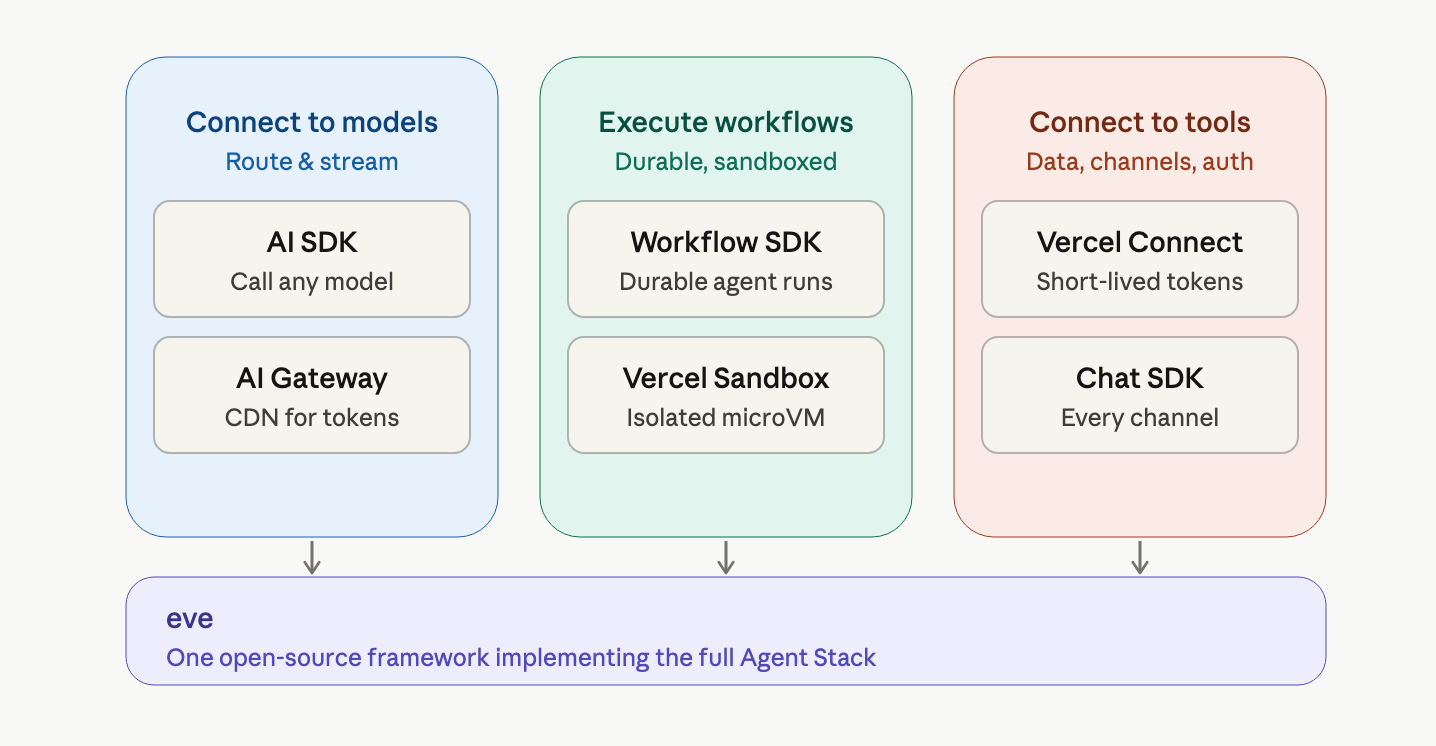
The genuinely new piece is Vercel Connect, which replaces long-lived credentials with short-lived tokens scoped to the specific person or agent that needs them, with audit trails, launching with integrations for Slack, GitHub, Snowflake, Salesforce, Notion, and Linear. [1] That solves a problem most agent deployments currently hand-wave: an agent holding a permanent API key is a standing breach.
The lock-in the framing skips
Here's where I push back. Vercel frames the choice as lock-in versus stitching versus DIY, then offers the Agent Stack as the way out. Adopting the whole stack is its own form of lock-in.
The honest split is within the bundle. AI SDK and AI Gateway are genuinely portable: model-agnostic, your own keys, no markup, designed to sit in front of providers you can swap. The orchestration layers bind tighter. Workflow SDK's durability (checkpointing every step, resuming from the last good step instead of from zero) is real value, but that state and those semantics live on Vercel. Same for Sandbox's per-agent VMs. Adopt the cheap-to-leave layers eagerly, and treat the orchestration layers as a deliberate commitment.
Three companies, three "stacks"
The word is being hollowed out as fast as it spreads. The same period Vercel shipped, Cloudflare released the Cloudflare One stack, but that's a set of skills you hand an agent to configure and migrate a Zero Trust network, shipped as two markdown skill files with explicit guidance for moving off Zscaler and Palo Alto. [2] A week earlier, O'Reilly ran "The AI Agents Stack (2026 Edition)," a conceptual six-layer map between your LLM and a production agent, arguing at least three of those layers didn't exist as categories when Letta drew the reference diagram in November 2024. [3] Chainguard, meanwhile, is maturing its own agent skills. [4]
These are three different things wearing one noun. Vercel's stack is infrastructure primitives. Cloudflare's is context and skills. O'Reilly's is a mental model. If you're evaluating "agent stacks," the first question is which of those a vendor is actually selling.
The O'Reilly piece has the line builders should tape to the wall: a team picks LangGraph, and three weeks later has 14 nodes in a state graph and a custom Redis checkpointer to answer refund questions a 50-line script would have handled. [3] Bundles make over-engineering frictionless.
If you're building on this today
Start with the portable layers. AI SDK and AI Gateway reduce real lock-in because they sit between you and the model providers, and you can leave with your keys. Reach for Workflow SDK and Sandbox when you actually need durability or isolation, and price in that you're committing to Vercel's runtime when you do. Look hard at Vercel Connect, because short-lived, scoped credentials for agents address a problem you probably already have in production. And when any vendor says "stack," make them tell you whether they mean infrastructure, skills, or a diagram.
Sources
Primary source: The Agent Stack
- Vercel launches a new framework and enterprise controls for agentic AI infrastructure - SiliconANGLE — reporting
- Introducing the Cloudflare One stack- agent-powered deployment - The Cloudflare Blog — reporting
- The AI Agents Stack (2026 Edition) - O'Reilly Media — reporting
- Chainguard Agent Skills matures - The New Stack — reporting