A 3-billion-parameter model just posted reasoning scores in the same band as models hundreds of times its size. Then someone on Hacker News asked it to draw the classic pelican SVG and got back a rectangle and a black circle. [1]
Both of those things are true, and they are the same story. VibeThinker-3B is not a tiny frontier model. It is a compressed reasoning core that happens to be very good at one narrow, verifiable kind of work, and the failures people are hitting are exactly the ones its own authors predicted.
The benchmarks
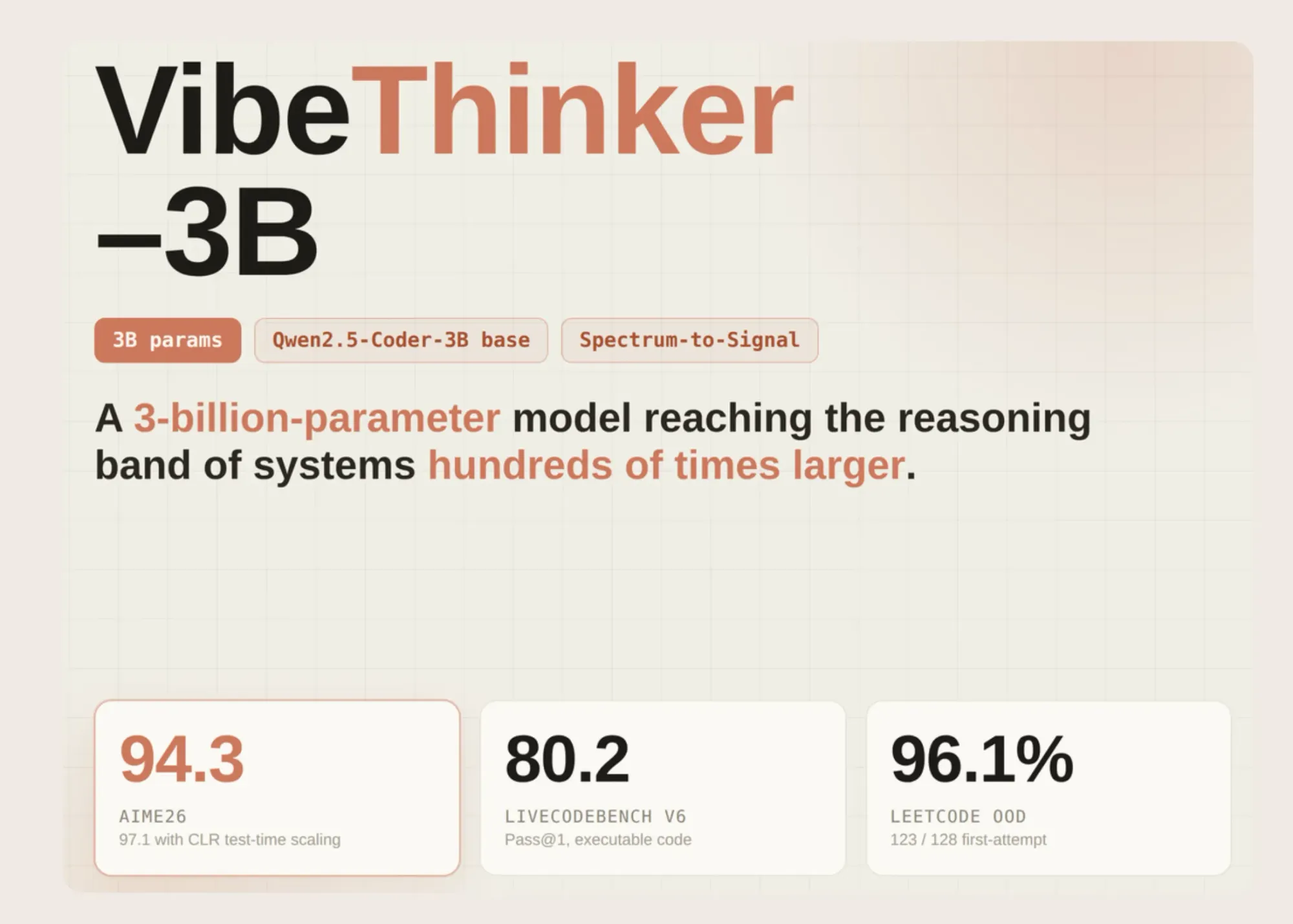
The numbers are real and they are striking for the parameter count. VibeThinker-3B scores 94.3 on AIME26, rising to 97.1 with claim-level test-time scaling, 80.2 Pass@1 on LiveCodeBench v6, and a 96.1% acceptance rate on recent unseen LeetCode contests. It also holds 93.4 on IFEval, so the reasoning tuning didn't wreck instruction-following. The paper places this in the performance band of flagship systems like DeepSeek V3.2, GLM-5, and Gemini 3 Pro — models that are orders of magnitude larger.
The recipe is a post-training pipeline they call Spectrum-to-Signal: curriculum-based supervised fine-tuning, multi-domain reinforcement learning, and offline self-distillation. No new base-model magic. The claim is that you can squeeze frontier-level verifiable reasoning into 3B parameters if you train the reasoning hard enough.
Where it breaks
Outside math and Python, the floor drops out fast. One commenter notes the headline results are Python-only and the model "will not do as well with other languages." [2] Another reports it is weak on structured output, which the model card itself flags. [3] And the pelican SVG, a long-running informal vibe check for general competence, produced shapes that don't resemble anything.
This isn't a model that is a little worse than Gemini 3 Pro across the board. It is excellent inside the verifiable-reasoning slice and noticeably hollow outside it.
What builders actually said
The sharpest framing came from a commenter who described it as a smart person who doesn't know anything about a given topic but, with the right tools, will go research the heck out of it. The appeal: "why have models train on learning anything when you can just train them how to learn." [4]
“Am I right in thinking this is a tiny model which has been trained well to reason, and that's it? Makes me think of a smart person who doesn't know anything about a given topic, but with the right tools will go and research the heck out of it. I really like the sound of this... why have models train on learning anything when you can just train them how to learn and let them get on with it from something as small as a Pi Zero and an internet connection.”
The security-review crowd split, and the split is informative. One builder is having real success running VibeThinker as a replacement for GPT-5 nano in source-code security review, on a single RTX 3090 with vLLM, working around the structured-output weakness in their own harness. [3] Another added it to a benchmark built from a corpus of previously discovered bugs and it found zero, concluding the smallest genuinely useful models remain Qwen 3.6 and Gemma 4. [5]
“It's terrible at hunting security bugs (I expected it to be, but I wanted to be sure). I added it to a benchmark I made with a corpus of some Mythos-discovered bugs, and it found zero. The smallest pretty successful models remain Qwen 3.6 and Gemma 4 (but I haven't tested the very small variants of those yet). https://swelljoe.com/post/will-it-mythos/”
Both can be right. Reasoning about code you hand it is a verifiable-style task; hunting unknown bugs across a real corpus needs broad world knowledge about what "wrong" even looks like. That maps cleanly onto where the model is strong and where it isn't.
Several commenters pushed on exactly that boundary. One argued there's a base level of intelligence any model needs to be useful even in narrow tasks, the way driving a car quietly requires reading, judgment, and anticipation. [6] Another went further: reasoning is never an isolated act, because the right and wrong way of doing things is codified in social context, and "everything affects everything to some extent." [7] That's the strongest case against the whole premise — that you can't cleanly amputate "reasoning" from "knowledge."
The hypothesis is the real result
Buried under the leaderboard flex is the actual contribution, and it's a good one. The authors propose the Parametric Compression-Coverage Hypothesis: verifiable reasoning compresses into a compact reasoning core, while open-domain knowledge and general competence need broad parameter coverage over facts, concepts, and long-tail scenarios.
Read that against the community testing and it predicts every result. Frontier AIME and LeetCode scores: reasoning compressed. Broken pelican, zero security bugs found, weak structured output: coverage missing. The builders weren't disproving the paper, they were confirming it one anecdote at a time.
So the "beats much larger models" headline is the least interesting thing here, and the most misleading. It's true on the axis the model was built for and false everywhere a working developer actually lives. The durable claim is that compact reasoning cores are a complementary path, not a cheaper substitute for a generalist.
There's a hardware kicker that makes this matter. At 3B, this class of model fits targets that frontier models never will — one commenter points out a model this small could run on a single Taalas ASIC, where half-decent reasoning would execute at "mind-boggling speeds." [8] A specialized reasoning core that runs on cheap dedicated silicon is a different product category than a general chatbot, and that's the bet worth watching.
If you're building on this today
Treat VibeThinker-3B as a reasoning engine you point at verifiable problems, not as a small generalist. Three concrete moves:
- Use it where answers are checkable — math, Python, contest-style coding, constraint solving — and pair it with retrieval or tools for anything needing world knowledge.
- Budget engineering time for the structured-output weakness; assume you'll wrap it in your own harness rather than trusting clean JSON.
- Benchmark it on your task before believing the leaderboard. The security-review split shows the same model can shine or score zero depending on how close your job is to verifiable reasoning.
The hype line is that a 3B model now matches Gemini 3 Pro. The useful line is that verifiable reasoning is more compressible than we thought, and general competence still isn't. Build for the second one.
Sources
Primary source: VibeThinker: 3B param model that beats Opus 4.5 on reasoning with novel SFT+GRPO
- HN comment by aero2146 — aero2146 · community
- HN comment by gslepak — gslepak · community
- HN comment by noperator — noperator · community
- HN comment by secretslol — secretslol · community
- HN comment by SwellJoe — SwellJoe · community
- HN comment by deftio — deftio · community
- HN comment by zkmon — zkmon · community
- HN comment by NotSuspicious — NotSuspicious · community
- Tweet by @mikefutia — @mikefutia · community
- Tweet by @expertwith_AI — @expertwith_AI · community
- Tweet by @StartupArchive_ — @StartupArchive_ · community